A closer look at the research
Semaglutide in STEP: making a fair dose comparison
How to decide which comparison a research result can support.
Clinician medical review has not been completed.
Choose the alternative first
STEP-2 randomized adults with overweight or obesity and type 2 diabetes to weekly subcutaneous semaglutide 2.4 mg, 1.0 mg or placebo for 68 weeks.[4]
ICH separates the clinical comparison from its estimate, specifying treatment, population, endpoint and handling of treatment changes.[2]
A fair comparison starts with the alternative being considered. Asking whether assigning different amounts changes a recorded outcome is a research question. Asking which amount a particular person should receive adds another question about that person's circumstances. An answer to the first does not automatically settle the second. Keeping them separate makes the research more useful: it identifies the part of a decision that an experiment could address without pretending that the experiment makes the whole decision.
Before looking at a result, try completing this sentence: compared with what, for whom, and judged by which outcome? Each missing phrase leaves room for a different interpretation. A comparison against no active treatment could address whether an intervention makes a difference at all. A comparison between active alternatives could address what changes when the alternative changes. Neither question is made more precise by calling one option simply better. The word needs an outcome attached to it.
There is also a choice about what counts as a useful answer. Fewer reports, less disruption and a greater chance of continuing could be separate goals. A result favorable to one goal would not logically establish the others. This article approaches the evidence through that distinction: define the comparison, inspect what the measurement retains, and then ask what additional observation would resolve the next uncertainty. The aim is a defensible interpretation of a dose comparison, rather than a dose recommendation.
What a common setting contributes
Post-hoc pooled adverse-event percentages were weighted.[3]
Consider the problem of comparing reports assembled under different entry rules. If one report admitted a broader population, a contrast could reflect the difference in who entered as well as the difference in the alternatives offered. The useful question would be whether the populations were comparable in ways relevant to the outcome, and whether enough information exists to assess that comparability.
Measurement creates a second possible mismatch. Suppose the same experience could be recorded under one collection rule but overlooked under another. A difference between the resulting counts would then combine a difference in experience with a difference in observation. A common collection rule would remove that particular explanation, although it would not guarantee complete reporting. This is why matching a symptom name is less informative than understanding the instructions, timing and opportunities for recording it.
A third issue is how a combined answer relates to the question of interest. If several settings contribute to a summary, changing their relative contributions could change which setting the summary best represents. That is an arithmetic property of combining unlike components, not evidence that any particular combination is wrong. To judge its relevance, a reader would need to know why that combination was chosen and which population it is intended to describe.
For a proposed comparison, I would therefore request the entry rules, baseline descriptions and collection procedures together. A shared setting is useful because it can make some alternative explanations easier to examine. It is not a certificate that every characteristic matches. The next step is to identify which differences are controlled by the design, which remain uncertain, and which would matter to the specific claim.
Read the paired display
Read a paired display by deciding what claim you want to test before interpreting the space between its marks. When estimates look close, the visual impression can invite the phrase close enough. But enough for what? A small difference might matter for one purpose and be acceptable for another. The choice cannot be recovered from the appearance of the graphic itself. It needs a reason tied to the outcome and the decision.
To defend a claim of equivalence, I would first specify the largest difference that would still count as acceptably similar, with a justification independent of the observed result. I would then examine uncertainty around the comparison under a stated analysis. If the range of compatible effects crossed that boundary, the interpretation would differ from a range contained within it. This is a proposed way to evaluate the claim, not an equivalence test being attributed to the research.
Uncertainty also belongs to the contrast, not merely to the visual separation of two marks. Asking how precisely each quantity is estimated and asking how precisely their difference is estimated are related questions, but they are not interchangeable. A graph should not encourage a reader to supply missing statistical information by eye. Nor would the absence of a declared difference, by itself, establish that a meaningful difference had been ruled out.
The direction of the question matters as much as its precision. Showing that one alternative is not unacceptably worse would be a narrower claim than showing that the alternatives are acceptably similar in either direction. A useful report would state which claim it intended to support before presenting its analysis. Keep that distinction beside the display: visual proximity can motivate a question, while a justified decision rule determines what evidence could answer it.
Within one trial
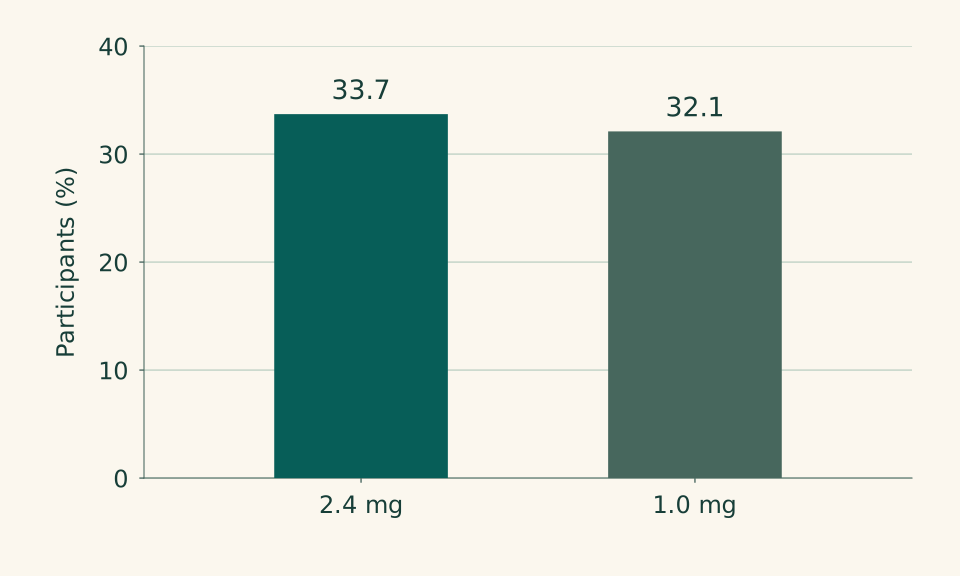
Read the chart as a table
| Dose | Participants (%) |
|---|---|
| 2.4 mg | 33.7 |
| 1.0 mg | 32.1 |
An occurrence does not measure burden
Pooled STEP-1–3 constipation-event medians: semaglutide 47 days; placebo 35 days. Not waiting advice.[3]
An occurrence measure answers whether something was recorded. To ask how disruptive it was, we would need to preserve information that a yes-or-no entry cannot contain. Duration, repeated occurrences and interference with ordinary activities could each contribute to a proposed burden measure. They are not interchangeable descriptions. A measure emphasizing how often something happens could rank experiences differently from one emphasizing how much of the day it affects.
For a future comparison, a diary could ask about a defined experience at agreed intervals and record its interference separately. Its value would depend on a clear definition of an episode and a consistent way to mark its end. Otherwise, an uninterrupted experience and a sequence of recurring experiences might be represented differently for administrative reasons. These are proposed measurement choices, not claims about an instrument used in the cited work.
The middle value in an ordered collection describes a position within that collection; it does not reveal its longest member. Adding episode durations would answer another question again, and could require a rule for overlapping experiences. A person-level account would also need to distinguish someone with one recorded episode from someone contributing several. Without that structure, converting one kind of summary into another would create information that was never supplied.
A carefully designed diary would still leave questions open. A missed entry would not automatically mean an unaffected day, and an interference score would need an explanation of what its categories mean. I would want the planned analysis to show how incomplete entries are handled and how the result changes under plausible alternatives. That would make a burden comparison interpretable without turning a research description into an expectation for an individual.
Who contributes to each comparison
Descriptive week-68 weight analysis required observed weight and dosing within two weeks; safety used 49 days.[3]
An analysis can be defined by both an assigned group and a rule about which observations contribute. An assignment question asks about the alternatives offered at the beginning. A question restricted to a particular pattern of subsequent participation adds a condition. The condition may be useful, but it should be visible in the interpretation rather than disappearing behind the name of the original group.
Imagine planning a future comparison with such a restriction. Before calculating an outcome, I would want a record of who meets the rule, which measurements exist, and which existing measurements are intentionally outside the analysis. That would separate two problems: an observation unavailable to the researchers and an observation available but not relevant to the chosen question. Treating those situations as identical would obscure whether the proposed remedy is better follow-up or a different analysis.
The consequences of a restriction cannot be assigned a direction just from knowing that it exists. If the excluded observations differed in ways connected with the outcome, the resulting summary could change. If they did not, the practical effect could be different. Establishing either possibility would require information, not reassurance or suspicion. A useful sensitivity exercise would state the alternative assumptions, explain why they deserve consideration and show which conclusions depend on them.
The companion analysis examines another comparison in which participation definitions deserve attention. Here, the broader lesson is to keep the research question attached to the records that actually answer it. Before carrying a result into a new claim, ask whether the new claim refers to the same eligible observations. If it does not, identify the additional evidence needed to connect them rather than silently enlarging the conclusion.
When a new comparison starts with selection
STEP-4 randomized eligible participants after 20 weeks of treatment, requiring target-dose attainment and continued use; randomized follow-up lasted 48 weeks.[5]
Suppose a future experiment invites only people who have passed an entry checkpoint. There would be a question about the alternatives available after that checkpoint, and another about what would happen to everyone approaching it. A good answer to the first could be valuable without answering the second. The distinction is about the people to whom the comparison applies, not about whether the narrower experiment was worth doing.
To connect those questions, I would first specify what qualification means and describe who does not qualify. It would be a mistake to treat that latter group as a single known experience. Different reasons for not entering could require different evidence. A lack of information about one reason would not justify filling it with an assumption drawn from another. The description of the entry process therefore belongs alongside any proposed extension of the result.
A fresh allocation after qualification could provide a new comparison among those eligible for it. It would not, simply by being fresh, undo the earlier selection of who became eligible. This can be expressed without assuming that the selection helps or harms the apparent result: the set of people in the new question has changed. Whether that change matters for a wider population is itself something to investigate.
For a broader research program, I would want linked information about entry, qualification and subsequent outcomes, with separate conclusions for the different questions. Combining those conclusions would require an explicit connection between their populations and alternatives. That is more demanding than arranging their results side by side, but it would make clear which decision each comparison can support.
Symptoms are not an assigned dose
Symptom groups were not randomized.[3]
A causal explanation has to distinguish an experience that changes an outcome from an experience that accompanies something else doing the changing. Consider several possible explanations as hypotheses. An assigned intervention could affect both a symptom and an outcome through separate routes. Another characteristic could influence both. Or a symptom could lie on a route leading to the outcome. A pattern of co-occurrence alone would not select one explanation from that list.
The next observation would need to discriminate between the hypotheses. Measuring when each event occurs could help rule out some proposed sequences, but an earlier event would not automatically be the cause of a later one. Recording candidate shared influences could make an explanation more testable, while leaving uncertainty about influences not measured. The important question is which competing explanation a new piece of information could actually exclude.
If an appropriate and ethical intervention were available to investigate a proposed pathway, its own effects would need careful consideration. Altering a symptom through an intervention that also affects the outcome directly would not isolate the symptom's contribution. The new comparison would mix the proposed pathway with another route. This is a design problem for researchers to resolve, not a reason for readers to try producing or suppressing an experience themselves.
A persuasive pathway analysis would therefore explain its assumptions, the order of measurements and the evidence against alternative routes. It would also distinguish evidence consistent with an explanation from evidence that rules competing explanations out. That distinction keeps a scientific interpretation open to revision. It allows an association to be informative without promoting it into a demonstrated mechanism or turning its absence into a personal test of whether treatment is working.
What would settle the next question
Novo Nordisk funded the trials and writing; three design-paper authors were employees and shareholders.[4]
The next dose-comparison study I would want to read would begin by defining a tolerability question that matters independently of the result. It could specify a burden outcome, a separate efficacy outcome and the conditions under which each will be interpreted. Keeping both visible would prevent a favorable result on one measure from silently becoming a claim about the whole treatment experience. Their relationship would be something to analyze rather than assume.
The plan would also state how observations after treatment changes will contribute to each question, and what efforts will be made to obtain them. It would specify the acceptable-difference rule where such a claim is intended, explain its justification and distinguish planned analyses from later exploration. A later question can be useful, but presenting it as later allows readers to assess how the data helped shape the question itself.
For reproducibility, I would ask for enough detail to trace a published estimate back to its outcome definition, eligible records and analytical choices. The point is not that a sponsor's identity determines the answer. It is that confidence should rest on evidence that another qualified analyst can examine. An explanation of how a conclusion changes under reasonable alternatives would be more informative than either accepting or rejecting it solely because of who supported the work.
Our editorial policy describes the publication's approach to evidence. The unresolved research question here is the strength of the comparison one wants to make, not a request for a more decisive slogan. A claim about acceptable similarity would call for the relevant uncertainty and decision rule; a claim about lived burden would call for a suitable measure.
Current care and reading scope
Wegovy is contraindicated with personal or family medullary thyroid carcinoma history, multiple endocrine neoplasia type 2, or prior serious hypersensitivity to semaglutide or product ingredients. Use is not recommended with severe gastroparesis. Persistent or severe abdominal pain needs prompt assessment; gastrointestinal fluid loss can injure kidneys. Gastric emptying is delayed.[6]
Compounded GLP-1 products are not FDA-approved.[1]
The citations attached to these statements lead to the product label and official material. The reference entry provides a separate place to read the defined product context. Keep the purpose of this article clear: it explains scientific comparisons and does not select treatment or interpret an individual's symptoms.
A service review is a different reading task: use it to examine dated provider documentation, then check the provider's current information. A trial result should not become an endorsement of that service. Questions about an individual care decision belong in a clinical conversation; the research analysis can help frame those questions without making the decision on the reader's behalf.
Reader questions
Why is a close-looking comparison not enough?
Close enough is a decision that needs a purpose. Before making it, specify which difference would matter and why, then examine uncertainty for that comparison. An estimate can look reassuring while leaving consequential alternatives unresolved. The useful distinction is between not seeing a clear separation and obtaining evidence that excludes the differences the decision would treat as important. Those conclusions require different support.
Can a symptom percentage tell me how disruptive it was?
It can answer an occurrence question, but disruption requires a definition of what is being counted as disruptive. A proposed measure might preserve duration, recurrence and interference separately before combining them. That makes it possible to see which aspect drives a comparison. Without those definitions, a broad label such as tolerability could hide several different questions, each requiring a different observation rather than a stronger adjective.
Would another trial answer the same question?
Only after checking the comparison itself. The relevant match concerns the alternatives, eligible population, outcome definition and observations included, rather than simply the treatment name. A difference in any of those features may create a useful new question. To combine answers, explain the connection explicitly and identify which assumptions it requires. Otherwise, apparently similar reports can be answering different questions without either report being mistaken.
What to take from the evidence
A defensible dose comparison begins with a claim narrow enough to examine. It separates the alternative being assigned from the outcome being recorded, and it asks whether the observation can support the intended conclusion. Visual closeness, a familiar outcome name and an authoritative setting are not substitutes for that work. The most productive next question depends on the gap. To judge acceptable similarity, define what would count as a consequential difference and examine uncertainty around the comparison. To understand burden, choose a measurement that preserves the experience the question concerns. To extend a conclusion to a different population or participation pattern, make the connection explicit and test its assumptions. This approach does not require every study to answer every question. It requires each conclusion to remain attached to the evidence capable of supporting it. A result can be useful within its stated comparison while leaving another decision unresolved. Knowing exactly where that boundary lies is a substantive scientific conclusion, not a failure to find one.
Scope of this article
This is an editorial interpretation of research, not an individual treatment assessment. It does not establish which option is appropriate for a particular person or endorse a provider. Clinical medical review has not been completed. The sources, their defined populations and the questions considered here set the scope of the discussion.