A closer look at the research
Tirzepatide in SURMOUNT: two ways to count discontinuation
How the endpoint changes the question a research result can answer.
Clinician medical review has not been completed.
Two endpoints ask two questions
SURMOUNT-1 studied adults with obesity or overweight without diabetes over 72 weeks; SURMOUNT-2 included type 2 diabetes. Treatment was weekly subcutaneous tirzepatide or placebo.[3]
Reading a discontinuation result begins with deciding what action is being counted. For a treatment endpoint, the question concerns use of the assigned intervention. For a participation endpoint, it concerns involvement in the research. These are different objects of measurement. Combining them under an informal description such as unable to continue would discard the distinction before the evidence had been interpreted. A careful reading keeps the action, its stated reason and the observation period together.
Consider how a research question would change if its objective were revised. A team interested in whether people could sustain an intervention would need a definition of sustained use. A team interested in whether outcomes could still be assessed would need a definition of completed follow-up. Neither objective supplies the other definition. An endpoint is useful when it matches the decision being investigated; it need not answer every reasonable question about the experience of treatment.
The denominator also belongs to that question. A proportion among everyone enrolled would address a different population from a proportion among people who had reached a later milestone. Before comparing results, specify who could have contributed to each count and when their opportunity to contribute began. Similar wording cannot repair a mismatch in eligibility. Conversely, a shared denominator would not make differently defined events interchangeable. The first task is therefore to retain the separate meaning of each endpoint while reading the display.
Two recorded outcomes
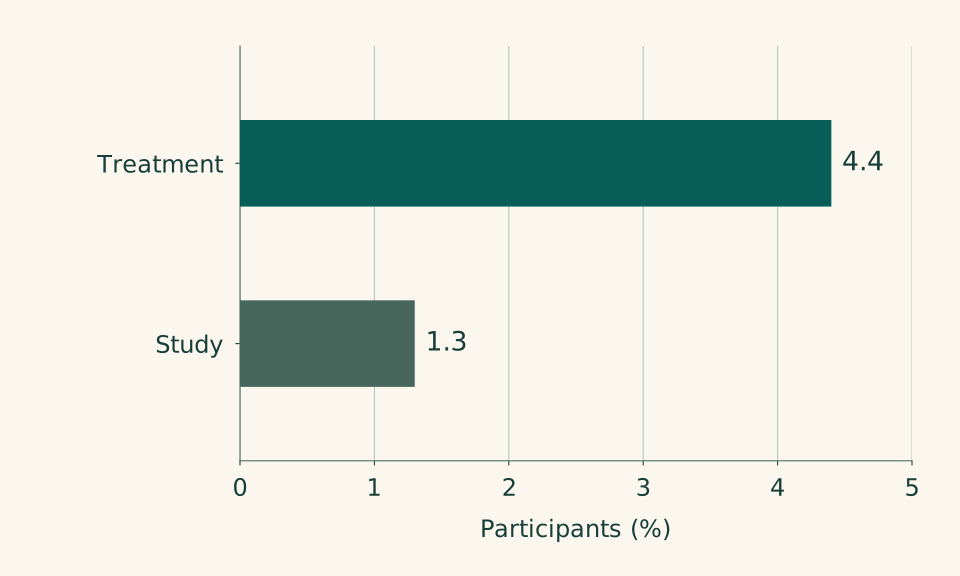
Read the chart as a table
| Endpoint | Participants (%) |
|---|---|
| Treatment | 4.4 |
| Study | 1.3 |
The missing joint record
ICH distinguishes treatment discontinuation from study withdrawal: the former can change the treatment-effect question; the latter concerns missing data.[2]
A useful proposed record would give each participant separate fields for treatment status and participation status. Those fields would allow a reader to ask whether both events occurred for the same person, just one occurred, or neither occurred within the chosen period. Totals for each field separately cannot reconstruct that pairing. Rearranging which records share an event can leave the separate totals unchanged while changing the joint history. This is a limitation of the information in marginal counts, independent of the clinical setting.
Pairing would be necessary but still insufficient for a claim about sequence. The record would also need dates, a definition of the first qualifying event, and a way to handle events recorded at the same visit. Otherwise, a reader could know that two actions occurred without knowing which came first. A description such as stopped and then left adds a temporal claim that a simple joint classification does not contain.
An observed sequence would raise a further question about causation. An earlier action could be followed by a later action without producing it. To investigate that relationship, a prospective analysis would need an explicit account of other circumstances that could affect both decisions and of what comparison would distinguish competing explanations. Even a detailed individual history cannot show what would have happened to the same person under an alternative course.
The practical aim is to request the record appropriate to the question. Pairing addresses shared membership, dates address ordering, and a defensible comparison addresses a proposed cause. Asking one of those records to perform all three jobs creates an inference that its structure cannot support.
The recorded reason matters
Adding a reason to an endpoint creates a second requirement for a record to qualify. An action must occur, and its documented explanation must meet the specified rule. A count defined this way could change if either the frequency of the action or the assignment of reasons changed. That means an apparent difference in the count could have more than one explanation even before considering any biological mechanism.
For a future study, the reason rule should distinguish a participant's account, an investigator's judgment and a conclusion reached by a separate review. Those would be different kinds of evidence. A form that permits several reasons would also answer a different question from one that requires a single primary reason. Neither design is inherently the right choice for every purpose. The choice should follow whether the study aims to describe experiences, summarize decisions or assess a particular causal hypothesis.
Multiple reasons would require an explicit counting convention. A report could preserve all selected reasons while identifying whether the associated categories overlap. Alternatively, it could assign one reason according to a prespecified hierarchy. The latter would simplify a display but would make the hierarchy part of its meaning. Changing the order of priority could move a record between categories without any change in the underlying experience.
Uncertain reasons deserve their own treatment as well. Forcing an ambiguous account into a definite category would conceal uncertainty rather than resolve it. A proposed analysis could show how conclusions change under alternative plausible classifications, with the alternatives justified before examining the desired result. That would test sensitivity to interpretation of the record. It would not establish a biological cause merely because the original coding rule used a clinical label.
Following people after a change
Weight observations after treatment stopping were excluded; SURMOUNT-2 also excluded observations after antihyperglycemic rescue.[5]
The program's treatment-regimen estimand includes outcomes regardless of treatment discontinuation.[3]
Three decisions need to be separated when planning an analysis: which outcome is wanted, whether a measurement was obtained, and whether that measurement is eligible for the chosen calculation. An available observation can be unsuitable for one question while remaining relevant to another. An observation that was never collected presents a different problem. Keeping those states separate prevents an analysis rule from being mistaken for a description of what happened during follow-up.
A proposed data set could retain the measured value, the measurement date, the relevant treatment history and a separate indicator of analytical inclusion. This would allow someone checking the work to distinguish deliberate restriction from absent information. Deleting an observation from the stored record merely because one analysis excludes it would make that distinction harder to examine and would remove options for answering a different question later.
Missing values would then require assumptions appropriate to the intended comparison. A sensitivity analysis could ask how strongly the unavailable outcomes would have to differ from those observed before the interpretation changed. Such an exercise should state the assumed differences and explain why they are worth considering. It should not present assumed values as recovered observations or select a favorable assumption because it produces the preferred conclusion.
Two analyses could therefore disagree without either being an arithmetic error. They might target different questions, use different eligible observations or depend on different assumptions about unavailable outcomes. A useful explanation would identify which of those features changed. Only after holding the question and analysis rules sufficiently constant would a numerical comparison help assess the effect of a particular methodological choice.
A symptom group does not explain a decision
Post-hoc symptom groups used any nausea, vomiting or diarrhea report; they were not randomized.[5]
A yes or no classification records whether a condition for membership was met. It does not encode all the information that might explain a later decision. For a proposed account of stopping, the useful additional questions would concern the order of events, how an experience affected ordinary activities, the options available at the time and the participant's priorities. These are candidate explanatory records, not established explanations of anyone's behavior.
Timing would be essential to that investigation. If a category used information collected after the decision being explained, a difference between categories could not automatically be interpreted as evidence about what led to the decision. The analysis would be mixing information from different stages of the sequence. A prospective design could instead specify the period during which candidate predictors must be recorded and the later period in which the decision is assessed.
Recording a possible explanation would not settle its role. A reported preference, for example, could reflect an earlier experience, a current constraint or a changing assessment of benefits. Treating it as a fixed background characteristic would impose an interpretation that the measurement alone does not provide. Repeated records with clear questions could help distinguish these possibilities, although they would still require an account of how the variables relate.
The central analytical task would be to separate description from explanation. A classification can organize records for inspection. A causal claim asks what would change under a different intervention or circumstance. Moving from the first task to the second requires a stated alternative and a reason the comparison can address it. More detail in the category label does not supply that comparison, and a larger collection of labels does not eliminate the need for one.
A withdrawal trial asks another question
SURMOUNT-4 randomized eligible participants after a 36-week lead-in to continue tirzepatide or switch to placebo for 52 weeks: 88 weeks total.[4]
A withdrawal experiment concerns a decision at a particular starting point. Its alternatives are defined at that point, after whatever qualification rules the design imposes. Asking whether to initiate an intervention would place the decision earlier and could involve people who never reach the later starting point. Those questions can both matter, but a result framed for one cannot be transferred to the other merely by retaining the name of the intervention.
Qualification also defines the population to which a comparison directly applies. Imagine a proposed experiment that requires completion of an introductory period. Its randomized comparison would address people who meet that requirement. Extending its interpretation to everyone who considered starting would require additional evidence about people outside that eligible group. This is a question about the reach of the comparison, distinct from whether assignment was conducted appropriately within the eligible population.
Planned assignment and an observed decision to stop also have different meanings. In a proposed withdrawal experiment, the investigator defines an alternative and assigns it according to the design. In an observational account, a decision could arise from circumstances that also influence subsequent outcomes. Comparing those situations as if they represented the same intervention would obscure what is being changed and how participants enter each comparison.
A useful way to evaluate a comparison is to write the decision, the eligible population and the alternatives in one sentence before interpreting the result. If the sentence changes when moving between studies, the reader has identified a change of question that needs to be addressed. The companion analysis offers another starting point for examining that fit between a scientific question and its comparison.
Testing a support strategy
A claim that support helps people continue would need a comparison of support strategies. Merely observing that support was available, or that someone used it, would leave the alternative undefined. For a proposed evaluation, the research team would first describe what each strategy includes, who is eligible to receive it and when assignment occurs. That would make the intervention a reproducible offer rather than an unspecified collection of actions.
Where appropriate, random assignment could compare the defined strategies while keeping the planned outcome collection consistent. The question might concern the effect of offering a strategy, which would retain the practical possibility that some participants decline or use only part of it. A separate question about actual use would need to account for how people come to use it. Selecting users after assignment would change the comparison and require additional assumptions.
The outcome should reflect the purpose of support. If the aim is to improve participants' experience, continued treatment alone would be an incomplete definition of success. A proposed evaluation could assess disruption of daily activities alongside decisions about treatment and participation. It should also record unwanted consequences of the strategy. An outcome set should allow improvement in one dimension to be considered alongside deterioration in another, rather than making continuation the only desirable result.
Timing and follow-up would need the same care. Assignment should precede the outcomes it is meant to influence, and outcome collection should not depend solely on continued use of the support. Otherwise, the evaluation could stop observing precisely the experiences relevant to the question. These requirements define a research design; they do not recommend a particular remedy or establish that any existing approach works.
What a complete report would show
Lilly funded the analysis; six authors were employees and shareholders.[5]
Transparency permits scrutiny of a conclusion; it does not predetermine that conclusion. A funding disclosure identifies relationships a reader should consider when evaluating how questions were chosen and results presented. It cannot, by itself, demonstrate that a particular result is wrong or that a particular choice was improper. Those judgments would require evidence about the conduct, analysis or reporting at issue.
For the questions developed here, a useful report would make the route from records to endpoints inspectable. A reader should be able to identify the qualification rule, the handling of ambiguous reasons and the point at which an action becomes a counted event. A reproducible specification would let another analyst apply those rules to the same eligible records. Agreement would check implementation; it would not establish that the endpoint is the best answer to the clinical question.
The proposed report should also make alternative interpretations distinguishable. If two conclusions rely on different treatment of unavailable observations, show that difference explicitly. If they rely on different definitions of the outcome, describe the definitions before comparing the results. This would prevent a disagreement about the question from being presented as a disagreement about calculation. It would also make clear what new information could resolve each uncertainty.
A reporting package has a useful stopping rule: include information that changes what can be inferred or allows the inference to be checked. More tables are not automatically more informative. A collection of separate summaries cannot replace a record that connects the relevant events, and a detailed record cannot replace a missing comparison. Readers can consult the editorial policy for the site's stated standards while assessing whether the reasoning in an article matches the evidence it presents.
Current care and product scope
Zepbound is contraindicated with personal or family medullary thyroid carcinoma history, multiple endocrine neoplasia type 2, or prior serious hypersensitivity to tirzepatide or product ingredients. Use is not recommended with severe gastroparesis. Persistent or severe abdominal pain needs prompt assessment; gastrointestinal fluid loss can injure kidneys. Gastric emptying is delayed.[6]
Compounded GLP-1 products are not FDA-approved.[1]
This article explains research questions and their limits. It has not received clinician review and should not be used to decide whether an individual should start, continue or stop a medicine. Read the linked product information in its full context and bring personal treatment questions to a qualified clinician.
The reference entry provides a separate place to read the compound overview. If considering a provider, the service review is a starting point for checking dated documentation about that service, not evidence of treatment performance. Questions about access, service terms and an individual's care should remain separate from conclusions about the research comparison.
Reader questions
Does stopping treatment mean leaving the study?
No necessary sequence is implied by the two terms. To answer what happened to particular people, a reader would need linked records defined over the same period. To say that one action preceded another would additionally require dates. To say that the earlier action caused the later one would require a comparison capable of testing that explanation. Keeping those questions separate avoids turning a possible sequence into an assumed pathway.
Can the chart show that symptoms were managed successfully?
A cessation endpoint is not a direct measure of successful symptom management. A management claim needs a defined approach, a meaningful alternative and outcomes that capture the intended benefit as well as unwanted effects. Continued use could be one outcome, but its interpretation would depend on that broader design. The relevant test is whether the evidence distinguishes the proposed benefit from other explanations, not whether a plotted value looks reassuring.
Which weight-loss question includes follow-up after stopping?
The treatment-regimen definition quoted above identifies the relevant target. A target specifies which outcomes matter to the question; it does not guarantee those outcomes were obtained. The next checks concern whether values were collected, whether they were included and how unavailable values were handled. Keeping those steps visible lets a reader distinguish a difference in the intended question from a difference in available evidence or in the assumptions used to analyze it.
What to take from the evidence
The most useful next question depends on the conclusion someone wants to draw. A statement about an endpoint needs a clear event definition and an appropriate population. A statement about an individual's sequence needs linked records and timing. A statement that a strategy improves experience needs a defined alternative and outcomes capable of detecting that improvement. These requirements should guide the request for evidence before a numerical result is interpreted. They also show why collecting more detail and constructing a better comparison solve different problems. Detail can clarify what was recorded without explaining what would have happened otherwise. A comparison can address an alternative only within its stated population and conditions. The strongest reading therefore connects each conclusion to the information and design that could support it, leaves unresolved questions explicit, and specifies which additional observation or comparison would make the interpretation more informative.
Scope of this article
This is an educational interpretation of selected research, not an analysis of individual participant records or an evaluation of a provider. It does not establish personal treatment suitability, explain an individual's decision, or estimate the effectiveness of a symptom-management approach. The proposed future research features are analytical suggestions, not findings from the cited studies.